- +920-202-3536
- service@mbintegratedpestcontrol.com/
- Mon - Fri: 08.00 - 17.00


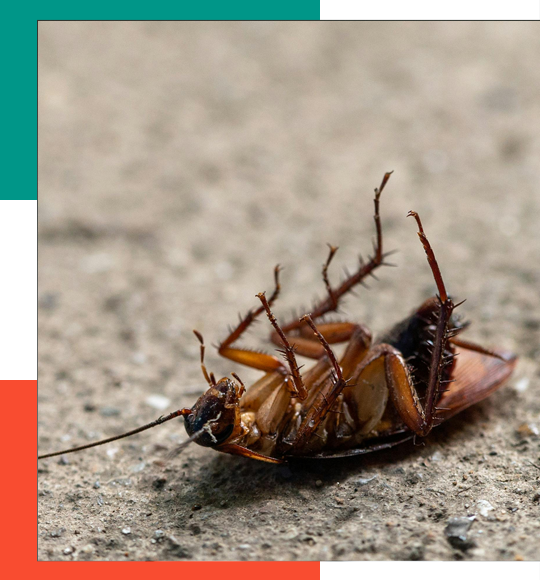


Cockroaches can pick up disease-causing bacteria, such as Salmonella, on their legs, which can contaminate foods, and cause food infections or poisoning.
House dust containing cockroach feces and body parts can trigger allergic reactions and asthma in human adults and children.
Adult American cockroaches are about 1.6 inches in length, reddish brown and have a yellowish margin on the body region behind the head.
Odorous secretions made by American cockroaches are strong enough to alter the flavor of food.
American cockroaches have three developmental stages: egg, nymph, and adult. Females produce an egg case (ootheca) which protrudes out the back end of the abdomen
(females produce an average of 9-10 purse-shaped egg cases). After about two days, she places the egg cases on a surface in a safe location. Immature cockroaches (nymphs)
emerge in 6-8 weeks and require 6-12 months to mature. Adult cockroaches can live up to an additional year during which females produce and average of 150 young.
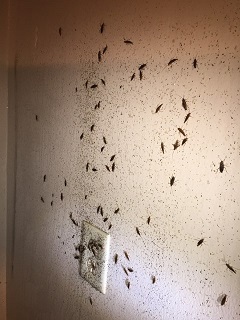
Measuring about ½ inch in length, the Brown-banded cockroach is tan to light brown, with two light-colored bands across the wings and abdomen.
The bands may sometimes appear to be broken or irregular but are quite noticeable. The male (wider than the female) has wings that cover the abdomen,
while the female has wings that do not completely cover the abdomen.
These cockroaches prefer 80 degrees or warmer, thus, more often found in upper cabinets in kitchens or bathrooms, or on the ceilings in dimly lit rooms.
The female produces egg-cases, like other cockroaches, and more apt to hide the egg-cases in or under furniture.
Only about ½ inch in length, the German cockroach can be tan to brown to almost black, and has two dark parallel streaks running from the head to the base of the wings.
This cockroach species produces faster than any other residential cockroach, going from egg to a sexually mature adult in approximately 123 days.
The female develops and egg-case (ootheca) on her abdomen and will noticably curl to the left or the right as it nears final maturation.
Nymphs will begin to hatch while the egg-case is still attached to the female; however, the majority will emerge within 24 hours after the egg-case is detached from the female's body.
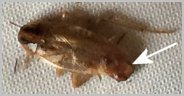  |
| Egg case extruding out backend |
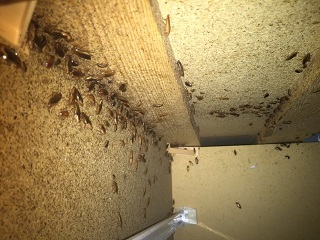
Glossy dark brown to black in coloration; females are usually 1¼ inches in length while males are usually only 1 inch in length. Males have black wings that cover most
of their body and female wings are no more than tiny lobes, thus, at first glance the female appears to be wingless.
Similar to other species of cockroaches, the female produces egg cases (oothecae), distinct egg compartments housing 16-18 eggs each.
The egg cases are formed a day after mating, then deposited in a sheltered area, or attached to a substrate by oral secretion, 1-7 days after formation.
The egg cases are initially yellow white, turning reddish brown then blackish brown, with nymphes hatching on their own in about 42 days.
Body length ranges from 1¼ - 1½ inches, they are dark brown to black in color, and both the male and female have wings longer than their abdomens.
The egg-cases produced by the Smokybrown Cockroach have a blunt point on one side and are dark-brown to black in color. Females produce about 17 egg-cases,
with each egg-case containing up to 24 eggs. The average life span of a Smokybrown Cockroach is about 250-300 days.
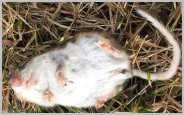
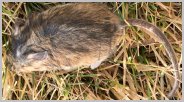
This mouse, commonly called the "Deer Mouse" or "White-Footed Mouse" in Wisconsin, is sometimes called long-tail field mouse or prairie white-footed mouse.
Other names include Baird's deer mouse, Baird's white-footed mouse, Michigan deer mouse, Michigan prairie mouse, Michigan white-footed mouse, Michigan wood mouse, and prairie mouse.
Measuring from notch to tip an adult deer mouse is usually less than 160 mm. in total length. The shorter tail is only 40% of the total body length (usually less than 65 mm.).
Little information is known of reproduction in Wisconsin. The mice commence breeding in March or April, and continue breeding into September. Litters are 3-5 pups.
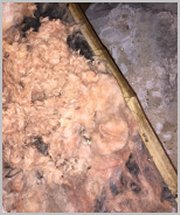
House mice infestations can happen quickly! House mice are only pregnant for about 20 days, and after giving birth can become pregnant again within just 12 hours!
If a female doesn't get pregnant again within the first 24 hours, she will be able to get pregnant again every 4-5 days onwards.
In a single litter a house mouse can have anywhere from 4-12+ pups.
The house mouse measures 6.3 to 7.9 inches and the tail measures 3.0 to 3.7 inches. The house mouse can be found in and around houses, stores,
warehouses, granaries, barns and other buildings; frequently in fields and meadows during summer months; and rarely in marshes.
The Norway rat (aka: the brown rat or sewer rat) is a destructive pest found in urban and suburban neighborhoods.
These rodents eat and contaminate food, damage buildings and other property by their gnawing and burrowing, and may spread diseases that affect people and pets.
These rats are husky, brownish rodents that weigh about 11 ounces. About 13" long, including the 6 to 8 1/2 " tail. Their fur is course and mostly brown with scattered black on the upper surfaces.
Norway rats will climb to find food or shelter, and they can gain entrance to a building through any opening larger than 1/2" across. They have litters of 6-12 young,
born 21-23 days after mating, and they reach maturity in about 3 months. Breeding is most active in spring and fall, and the female has 4-6 litters per year.
As the seasons change from summer to fall, roof rats are on the move--to indoors in search of their preferred nesting places, in the warmer upper level of homes and garages.
Roof rats like to gnaw the wires and hoses under car hoods, boats and motorhomes; gnawing on anything to keep their front teeth from growing too long, even concrete.
They eat almost anything, but they prefer stored foods, fruit, vegetables, nuts and pet food (especially cat food).
May spread diseases that affect people and pets An infestation of roof rats in one home means as much as 6 out of 10 nearby homes will be infested, thus,
the entire neighborhood will need to be vigilant, work together to eradicate these pesky, plague-carrying vermin (transmit disease by droppings and urine,
bites, and the fleas and mites in their fur).
The roof rat measures anywhere from 13-18 inches, including its tail, weights 5-9 ounces, and have large, almost naked, ears.
They prefer to live four feet or more off the ground, and can squeeze through a hole the size of a quarter.
Females have 4-6 litters per year, with 6-8 young per litter. The young mature in 2-5 months, and are adults for 9-12 months. Pregnancy takes 3 weeks.