- +920-202-3536
- service@mbintegratedpestcontrol.com/
- Mon - Fri: 08.00 - 17.00




Wasps are not bees! Yellow Jackets and many other wasps and hornets get bad press for
a reason--they are often aggressive, uninvited guests, and are NOT significant pollinators.
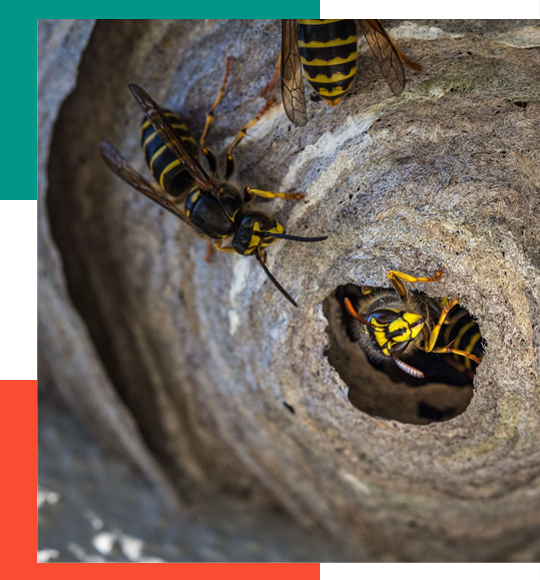
Wasps nest in papery hives above ground or underground. The wasps are relatively hairless, and have pointed abdomens. These ill-tempered hotheads readily sting people.
True bees are usually hairy, are much more docile and usually don't sting unless they are stepped on or forced to defend a nest site. Gardeners and farmers, alike, need bees for pollinating plants.
Hornet stings are more painful to humans than typical wasp stings; the pain may persist for several days with attendant swelling. A hornet can sting multiple times and, unlike honey bees, hornets and wasps do not die after stinging because their stingers are not barbed, thus, not pulled out of their bodies after stinging.
People who are allergic to wasp venom are also allergic to hornet stings.
Bald-faced Hornet
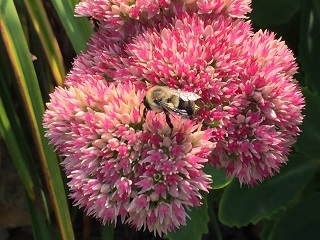
Bumble Bee
Honey Bee
Hornet
Yellow Jacket Wasp
Paper Wasp
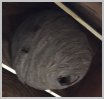
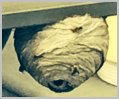
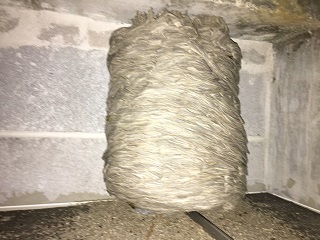
Bald-faced hornets are extremely aggressive when disturbed and WILL STING repeatedly. It is NOT considered safe to approach the nest (often football-like in shape) for observation purposes. The bald-faced hornet will aggressively attack with little provocation. Read More =>


The European Hornet is the best-known species, and the only species introduced to the U.S. In general, hornets are the largest eusocial wasp with the European hornet about 2-3.5 cm in length.
The nest of a European Hornet can be underground, inside large cracks in trees, attached to the framework of houses and structures, or buried in long grass (like the above photo).
As the colony size grows, the hive is expanded. At the peak of its population (late summer), the colony can reach a size of 700 workers.
The nests are founded in spring, by a fertilized queen. She first builds a series of cells (up to 50) out of chewed tree bark. An egg is then laid in each cell and,
after undergowing 4 weeks of various stages of development, the first generation adults emerge (invariably females).
The new workers will take over all tasks formerly conducted by the queen, except egg-laying, which remains exclusive to the queen.
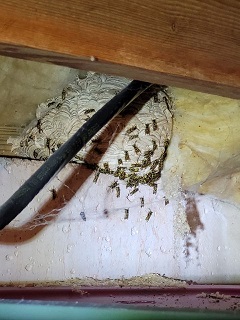
Paper wasps are somewhat aggressive when feeding, but are the poster child for "aggressive" behavior near their nests! Individual wasps will take issue with your presence and also release a pheromone--an airborne communication--that incites the rest of the wasp inhabitants to riot...all with the ability to sting over and over. Read More

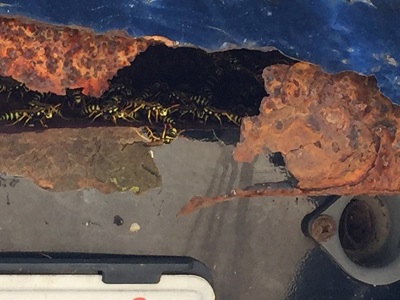
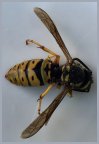
The yellow jacket wasp will sting repeatedly and is primarily only dangerous to humans who are allergic or are stung many times.
Spring through summer, yellow jackets (a wasp) bring insects, meat and fish to feed larvae in their rapidly growing colony.
By late summer or early September, the larvae are all grown and the result is about 5,000 hungry adults looking for meat and natural sugars to fuel their full-flight metabolisms.
According to researchers at the University of Maine, on a bee-for-bee basis, bumble bee species are eight times more efficient than honey bees at pollinating some highly-valued crop types.
The bumble bees are more effective because they will fly in cooler temperatures, damper conditions and lower light levels extending pollination by several hours each day.
Should there be a human family history of allergic reactions to bee stings near a bumble bee hive, MB Integrated Pest Control will conduct extermination procedures;
removing a most serious health risk.

The population of a healthy hive in mid-summer can average between 40,000 and 80,000 bees.
Protecting the Honey Bee - Once properly identified, and the honey bee hive located, MB Integrated Pest Control will gather pertinent information and
contact a reliable beekeeper to set up hive relocation procedures.
Fun Fact: One of many honey bee species, the Western Honey Bee (aka: European Honey Bee) serves as the Wisconsin state insect (as of 1977).